
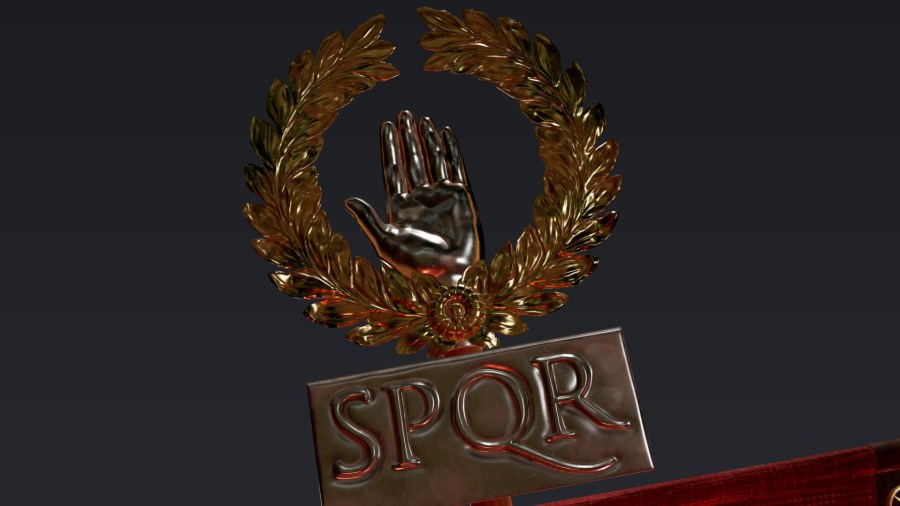
Although commonly dismissed as merely a language convention, nomenclature is in actuality a subject of paramount importance in the study of history. It shapes the medium through which we interact with the primordial crucible of the past, and hence determines how we perceive the events, concepts, polities, and figures that comprises the discipline of history. Many of the modern names which we use daily in historical dialogue are anachronistic, contingent not to the bygone age which we study but chosen arbitrarily by prestigious scholars of the enlightenment and beyond. The use of these names not only signify a reductionist approach to history that obfuscates and distorts the truth, but also a lack of respect for our ancestors. This short article hence strives to elucidate the reality of nomenclature in the ancient world, not to shame or denounce those who employ the anachronistic conventional terms, but merely to introduce a new perspective by recreating an often absent sense of authenticity.
“The Roman Empire” and “the Roman Republic” are in reality names which were never used by the Romans to describe their dominion, and the distinction which we ascribe to the two probably never existed in actuality. The Romans at first called the extent of their political influence Imperium Romanum, describing the extensive outreach of their sovereignty over the myriad peoples of Africa, Europe, and Asia. When the various disparate ethnic groups included within Imperium Romanum became homogenised and romanised at the turn of the second century AD, the Romans took to calling their polity Romania—Land of the Romans.
The Roman Republic, or Res publica Romana, was not the name of the Roman government before the accession of Imperator Caesar Augustus, but the term coined to represent the collective interests of the Roman citizenry. The founding creed of Rome, the one principle which defined her and set her apart from every other city state, was the promise that all citizens, no matter how poor, how ugly, or how unfortunate, would receive their fair share in Rome’s boundless glory. This, was the essence of Rome, the overarching political philosophy of the Eternal City, and none could be allowed to defy it, be they kings, gods, or senators. When the old Etruscan monarchs failed to live up to this promise, they were cast out, banished, and replaced by the Senate. And when in the first century BC, the senatorial aristocracy itself became a malignant cancer on the apparatus of the state, greedily hoarding for themselves the spoils of conquest, they too were deposed, diminished, and subjugated by a new form of autocracy.
The concept of the Roman Republic survived for the entire duration of Roman history, all the way from Romulus and Remus to the sack of Constantinople in 1453. This was owed to the fact that it was tied not to the nature of government, but the purpose of government. Monarchy, democracy, oligarchy—these words meant little to the Romans for as long as their individual interests were adequately appeased and represented by the regime in power. And thus, when Imperator Caesar Augustus cemented his position as an autocratic leader whose successors would rule Rome as sovereigns for centuries to come, he truly did restore the Res publica Romana. It was not a lie propagated to pacify the people, but a political reality. Caesar Augustus’s government led Rome with vigour and efficiency unmatched by the Senate, and the common men and women of the streets benefited directly from the reforms which the Augustan regime enacted. Unlike the modern world, in which we are taught to associate certain political beliefs with predetermined prejudices, the Romans could accept any form of governance for as long as they prospered.
This does not mean that the Romans had no prejudices of their own. When Caesar Augustus became master of the Roman world, he carefully avoided any regal titles, rituals, or accessories. He did not in fact even create an office of autocracy for fear of conjuring up harrowing memories of Rome’s ancient monarchs. Instead, he derived all his executive powers from magistracies of the Roman city state. Hence, describing him and his successors as “emperors” betrays the ideological foundation of their leadership, for it is a title that is unmistakably monarchical in nature. This umbrella term was created likely for convenience, as the “emperors” did not have a chosen title, rather, they simply added to their own name that of their progenitor’s—Imperator Caesar Augustus. For example, Constantine the Great would have been referred to in full on coins and documents as “Imperator Caesar Flavius Constantinus Augustus” when he became ruler of Imperium Romanum.
The reason why I believe that it is paramount that the title of Imperator Caesar Augustus be widely employed in historical academia is that it signifies the three pillars of Augustan imperial governance: army, people, state. Imperator, the word that served as the root for “emperor”, has no regal connotation in the Roman political language. It is merely an honorary title which legionaries bestowed upon generals who have led them to victory and are deserving of a triumph. Caesar was a cognomen popularised by Gaius Iulius Caesar, conqueror of Gaul, victor of the civil wars, and the last dictator of Rome. Its adoption in imperial nomenclature is emblematic of the prevailing importance of the people in Roman imperial politics, for Caesar was famously an advocate of the common man. And lastly, Augustus was a title granted to Imperator Caesar, the first master of Rome, to celebrate his piety, diligence, and prestige and his conviction to restore the Res publica Romana. It embodies the magisterial nature of the imperial office, as like every other republican honour, it was bestowed with popular and senatorial consent, and represents the constitutional foundation from which Imperator Caesar Augustus derived his legitimacy.
Artist Credit: https://www.artstation.com/artwork/8eOyWG
 Veni Vidi Veritatem
Beautifully written, Michael. Really interesting ideas explored – I agree with you that our current terminology, which infuses certain connotations and prejudices into what they serve to represent, actually does distort our perception of history. Thus, putting their origins and meaning in light can help us form a clearer view of our past.
It’s also interesting to note how our current assumptions about democracy and autocracy, shaped by the interests of the Western world, differ from the Romans.
This is really amazing stuff, keep it up!
LikeLiked by 1 person
Everything is very open with a precise description of the issues. It was definitely informative. Your site is very useful. Many thanks for sharing!
LikeLike