
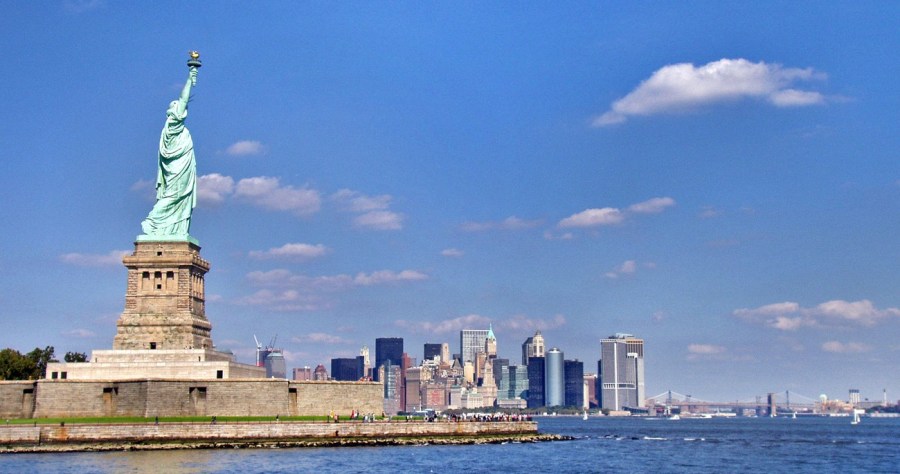
Today, there is perhaps no defining feature of the West more than the ideal of ‘liberty’, immortalised in word – ‘Liberte, Egalite, Fraternite’ – and manifested in material – the Statue of Liberty and money. We see this term as an inalienable human right, a juxtaposition of tyranny, and a sensationalist ‘mission civilisatrice’ to liberate the woes of the oppressed. Yet beyond its weaponisation in modern-day politics, is this definition of ‘liberty’ truly so universal? In my months-long travel throughout China, conversing with farmers, taxi-drivers, white-collar workers, and a communist, I have truly become intrigued at what makes authoritarianism so ‘acceptable’ in this socialist nation. Is it really just censorship, terror, and political brainwashing? Or is there a deeper culture at play? This opinion piece is my reflection.
My reflection begins with the meeting of a young woman, Ms Rei who revealed herself to me as a proud communist. Startled at first, yet united by our common passion in history and desire to be open-minded – she being not only conversational in French as part of her master’s degree, but having also visited the United States prior – it was her initial curiosity at ‘how the West viewed us [them]’ and my desire to understand politics holistically that culminated in my intrigue at the autocratic nature of the Chinese Communist Party.
For years, it has been widely observed of the increasing authoritarianism and militarism occurring within China. Ever since President Xi’s removal of presidential limits in 2018, China has become increasingly forceful on the Taiwan issue (in conjunction with other territorial assertions) and the social and political adherence to ‘Xi Jinping thought’, through purges, propaganda, and intensified national security. In my travels, through the most prosperous megacities of Beijing and Shanghai to one of the most impoverished here in Lanzhou, Gansu (second lowest nominal GDP per capita out of all provinces in China), I have seen more slogans mentioning Xi Jinping than Mcdonalds Ads, and more security personnel, police officers, and SWAT teams than in a first-person shooter game. Indeed, these sights may appear eerie or alien to me or you, yet what about the ordinary? What about those that go to school each day, to work, back to home, to the grocery store, and to the hospital? What do they make of these sights, perhaps so abrasive to even their standards and memory?
Little. There is neither the subservience and tyrannical oppression that Western media would report, nor the patriotic fervour expected of Nazi Germany. This observation, of course, does not deny the existence of these nationalistic sentiments – Ms Rei having admitted that if given the opportunity, she would be willing to sacrifice herself for her nation as her ideological predecessors had – yet for the ordinary, the aforementioned instances of surveillance and ideological promotion remain superficial in their daily lives, perhaps even welcomed. The battalions of police officers lining the rows of public streets during festivities and the mass, public surveillance? Because of these security measures, China has never become any safer to travel. I remember only ten years ago, travelling as a child seeing parents leashing their children to their wrists in fear of public abductions, and the iron bars inside taxis to separate the passengers from the drivers. Today, crimes are unfamiliar within the crowded suburban setting, taxis made safer – in part due to the multiple cameras placed within – and travel made carefree. Indeed, the mentality here very much is: there is no fear if you have done nothing ‘wrong’.
Of course, it would be deceiving to not view this advancement in public security as in some ways concerning, given the authoritarian setting. There is simply no guarantee that what is ‘wrong’ will be safeguarded to that of general criminal offences or what may be promoted today will not become mandatory tomorrow. This seemingly inevitable transition from ideological authoritarianism to some form of ideological extremism has been read in the history books of Joseph Stalin, Adolf Hitler, and Mao Ze Dong far too often. Yet I assert that we do not fall on this slippery slope just as we trust that American conservatism does not lead to facism. The social and political policies of China today should be evaluated with contextual concession, not ideological aggression. To finish my point off, if I were to see a SWAT armoured car in the CBD tomorrow, I would be terrified because there is no justifiable presence of such force and infringement of my privacy or liberty in our Western society. The same cannot be applied to Chinese society, which understands the necessity to curfew certain liberties such as public privacy on occasion, because efficiency far outweighs vulnerability, just as pragmatism does passivity.
But what about the ideological infringements on civil liberties such as the freedom of speech? How is it so ‘superficial’ as I mentioned above in the ordinary Chinese psyche, despite its supreme importance in the very fabric of Western society or the tragic reality of public censorship online of ‘anti-CCP’ ideals? How is it even comprehensible that 1.4 billion humans could be compliant to the invalidation of the most inalienable of human rights? My answer: culture. Not a culture of subservience, but a culture that demarcates political philosophy from their daily lives, a culture that is not obsessed with self – in this case whatever liberty they feel deprived of – but the prioritisation of homogeneity within their family and community.
This part of the reflection stems from a conversation with a taxi driver I encountered a few weeks back. Belonging to a class of low socio-economic status within modern day China, he was visibly annoyed, perhaps even disturbed by an instance of corruption he faced within the bureaucracy of the Chinese Education Department in Lanzhou. Seeking to secure the best education for his son, like the millions of others within China placing their faith in good education to transform their social circumstances, he found registration to the best public elementary schools impossible due to the prioritisation of children from bureaucratic families holding positions in government. He goes as far to describe an older lady on her knees in front of her local Education Department, begging for enrollment at the very elementary school that he tried to waitlist for. Even when inquired of his own financial future, he remained despondent, exclaiming himself that he has no hopes for a better life. His resentment against the social beaurocracy and economic policies was evident, yet there was little he could do within the political atmosphere of China today.
Perhaps surprisingly to you readers, his feelings came as a major shock to me. Indeed, only a week before, I had met a regional farmer who spent the winter opting to drive tourists up and down Mt Gaolan (Lanzhou’s tallest mountain). One of the passengers, curious at their agrarian way of life, asked whether their lives had improved in recent years under the local government. His reply was that although he wishes for more funding in his locality, he felt there was a general improvement of financial security in his small village. Hearing his perspective, for a short while, I was confident that the lives of the ordinary, on average, were generally improving under the CCP in recent years and in comparison to the social turmoil that China had been engulfed in during the 20th century.
Yet, listening to the taxi-driver, his words came as a sudden and stark reminder that the cruel nature of society bears both winners and losers, only in a developing nation like China, it is truly difficult to ascertain whether there is more of one than the other.
I digress, however returning to his struggles, it was his next words that became a defining moment in my reflection. He says: “I may have no hope for myself, but my only goal is to take care of my parents who brought me up, and bring up my son as my parents had me. For that, I will be happy.”
So, what makes authoritarianism tolerable in China? What makes Western ideals of liberty so abstract here? Because they are not the focus. The Chinese psyche is one centred around community, not self – a homogeneity I envy to experience here in Australia and reflected by the Chinese proverb ‘远亲不如近邻‘ (a distant relative is not as good as a neighbour). Through generational hardship in the modern era, their ability to take care of others is their liberty – their freedom from worry and anxiety.
The matter of Chinese and Western tension is one of historical and political complexity. In truth, it is a topic difficult to explore and engage with, neither black nor white, and I believe we hold a responsibility to readily admit that. What we make of our future world is of uncertainty and self-perspective; bias is natural and unavoidable. Yet, if there is anything I have gained from exploring both cultures, it is that we must be able to always consider the other side – to put ourselves in each other’s shoes and understand.
IMAGE: Credits to National Park Service https://www.nps.gov/stli/planyourvisit/index.htm
 Veni Vidi Veritatem