
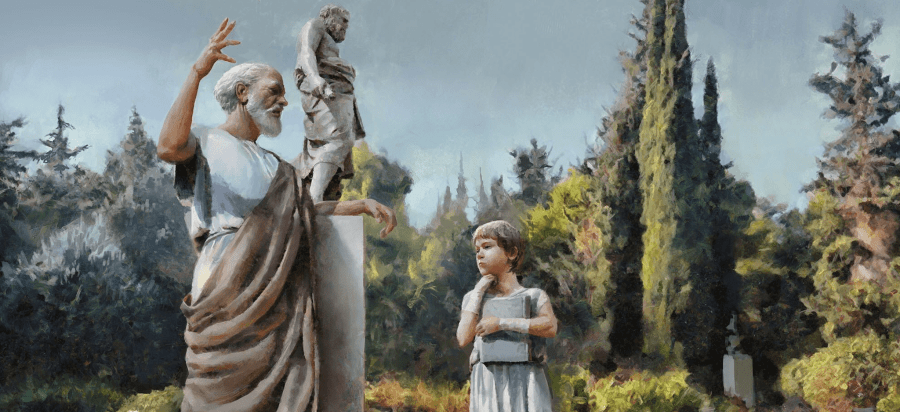
A long long time ago, there once lived a sage who was so wise that he knew of all the mountains and the seas of the world. He had witnessed wonder and terror beyond comprehension. Through books and scrolls his mind soared high, and took him to where his feet could not tread. And so he sat beside an olive tree, and spoke of legends past, of great heroes with ichor in their blood, of great battles with the most valiant warriors of men, and he spoke of cities, so magnificent, so grand, that the gods dwelled therein. His wisdom amassed him students, who came and listened to the wonders in his words under his olive tree.
And there was a young man who dreamed of great heroes with ichor in their blood, of great battles with the most valiant warriors of men, and of cities, so magnificent, so great, that the gods dwelled therein. So he sought out the wise sage under the olive tree, and asked the wise man: how may he tread the paths others dare not walk, and how may he see the wonders too great for others’ eyes.
And so the sage produced a map, on it he labelled all the wonders of the world, of cities that existed only in myths, of Bablyon, of Sidon, of Tyre, of Memphis, of Persepolis, of Susa, of the great grass steppes, of the land of five rivers, and of golden desert dunes. “These places aren’t ours to reach,” said the sage so wise that he knew of all the wonders of the world, “but fret not, my child, I have witnessed these wonders without ever setting foot beyond the gates of my city, for I have many eyes that are not my own.” And then he produced ancient scrolls, books, and tablets, written by men that came before, men who were so wise that they knew of all the mountains and the seas. “Read these,” he said, “and you shall behold all the wonders the world has to offer.” But his young student was not satisfied. “How may I behold these wonders with my own eyes?” he asked, his cerulean pupils gleaming with light, “how may I become the great hero with the blood of gods, how may I do battle with the most valiant warriors of men, and how may I build cities, so magnificent, so great, that the gods dwell therein?”
And the sage was silent, and his ancient face did crease and frown.
“My child, the world is so vast that no one could see all the mountains and the seas, the heroes are so great that we may never live up to their fame, and the cities are so magnificent that no other may surpass them in their majesty,” the wise sage replied, “that is why we read, my child, that is why we wonder, to look up to the titans whose height we may never reach.”
But within the child burned a fire unknown to the sage, and when the time came he left his wise teacher under the olive tree to see all the mountains and the seas of the world for himself. His teacher only chuckled, for he knew that his student would soon return, disheartened by his failure to even cross the Hellespont, for it was a feat unaccomplished even by Hercules.
For thirteen years he waited, and his student did not return.
One day, when the sage was a dying man under the olive tree, a withering flower, and a fading memory, a chest arrived at his house. Within it were rings of Persian gold, incense of Susa’s scent, gems of Babylonian hue, robes of Tyrian purple, swords of Sidonian steel, fruits of the Nile delta, lotus of the Indus valley, and many more wonders galore. And there was a map of the world, greater than the one the sage had owned, upon it was drawn lands never before tread and never before seen. Alongside the map there was a portrait, a vivid depiction of a great hero with the blood of the gods, fighting the battle with the most valiant heroes of men, within a city so magnificent, so great, that the gods dwell therein.
When the sage died, they called him Aristotle the Wise, but when his pupil died, they called him Alexander the Great.
 Veni Vidi Veritatem
Beautiful 💛💛💛
LikeLiked by 1 person