
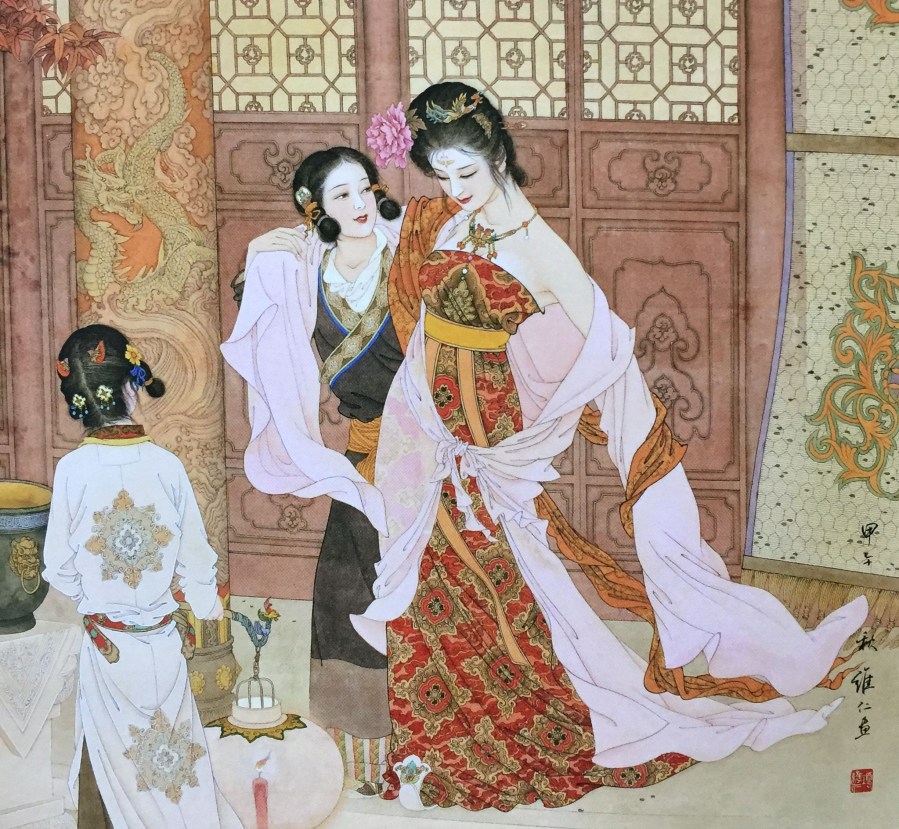
What follows is the final part of my interpretation and translation of 白居易‘s 长恨歌. Ancient Chinese literature is notoriously difficult to translate to English due to the sheer amount of mythological, idiomatic, cultural, historical, and literary references through which meanings are conveyed in the Chinese language. By reading a poem such as this, one can see the whole breadth of Chinese history unfolding before one’s eyes. English as a language, on the other hand, is entirely devoid of such references (speakers of Greek and Latin should be able to appreciate the difference), since the vast majority of English speaker are ignorant as to what even constitutes the meaning behind English words. Imagine if instead of diversifying into a myriad different tongues, all the languages of the Mediterranean merged into one concise, simplicit, intuitive, and eloquent language that had been in use in a very recognisable form since 200 BC—that is Chinese. The beauty inherent to well-written Chinese is wholly unique, and dare I say, unparalleled, and by translating a favourite poem of mine into the current universal language, I merely hope that more people may come to appreciate this ageless treausre of mankind.
I tend to prioritise literary flourish and textual beauty over preserving the exact meaning of the original text when I translate, preferring to convey the same meaning by using linguistic counterparts when possible, but drawing upon external references when it’s applicable. Even so, I’d say that at least 70% of the beauty of 白居易’s work has been lost in translation. Also of note is that normal Chinese people don’t write like this anymore, this is very much an ancient form of Chinese known as 文言文 that is still widely studied, but rarely appreciated nowadays.
临邛道士鸿都客,能以精诚致魂魄。
There arrived at court a Taoist from the east, who claimed to commune with bygone ghosts.
为感君王辗转思,遂教方士殷勤觅。
Moved by his liege’s love, the man endeavoured to quell his sorrow.
排空驭气奔如电,升天入地求之遍。
Aether and earth, cloud and thunder, everywhere he searched.
上穷碧落下黄泉,两处茫茫皆不见。
High above the heavens loomed, deep below the yellow spring flowed, to both he travelled, but never could he her phantom find.
忽闻海上有仙山,山在虚无缥缈间。
Then he heard of a celestial mount, floating weightless among the clouds.
楼阁玲珑五云起,其中绰约多仙子。
Amidst five-coloured clouds towers rose, there heavenly beauties dwelled.
中有一人字太真,雪肤花貌参差是。
Among them was one named Taizhen, ivory skin, glamorous visage.
金阙西厢叩玉扃,转教小玉报双成。
To the Golden Palace the sovereign’s emissary sped, carrying a letter bound for the sky.
闻道汉家天子使,九华帐里梦魂惊。
The Son of Heaven’s herald broke her slumber, dreams and memories swirled.
揽衣推枕起徘徊,珠箔银屏迤逦开。
Half dressed she rose, only to halt in ponder. Upon her head she donned the pearl-screen crown, glistening beads concealing a troubled visage.
云鬓半偏新睡觉,花冠不整下堂来。
Sideways her cloud-like hair swayed, her flowery crown hung awry.
风吹仙袂飘飘举,犹似霓裳羽衣舞。
Wind blew her celestial sleeves, swaying like strands of cloud, empyrean rhythm, peerless dance.
玉容寂寞泪阑干,梨花一枝春带雨。
A beautiful countenance stained by tears, glamour laced with misery.
含情凝睇谢君王,一别音容两渺茫。
The melancholy her eyes could conceal no longer. Dewy-eyed, her voice quivered as she thanked her liege.
昭阳殿里恩爱绝,蓬莱宫中日月长。
The Imperial Palace* lies beyond reach, in the Celestial Palace the days are without end. The bond of love had long been severed by fate.
回头下望人寰处,不见长安见尘雾。
A head’s turn, a sorrowful smile, where Changan[1] once stood she could see only formless smoke.
惟将旧物表深情,钿合金钗寄将去。
Such emotions she could convey only with past life’s treasures. Crimson hairpin, gilded crown, she bid him return to the Son of Heaven.
钗留一股合一扇,钗擘黄金合分钿。
The golden crown top and twin hairpin she left behind, one for her, one for her lord.
但教心似金钿坚,天上人间会相见。
May their bond be as strong as gold, one day in the heavens they shall meet again.
临别殷勤重寄词,词中有誓两心知。
Before departure a poem she wrote, hidden within words an immortal oath, known only to two.
七月七日长生殿,夜半无人私语时。
Seventh of July, Palace of Long Lives, whispers amidst midnight bells.
在天愿作比翼鸟,在地愿为连理枝。
In heaven may they be matching birds[2], on earth may they be connecting branches[3].
天长地久有时尽,此恨绵绵无绝期。
Even the heavens and earth will one day perish, but such everlasting regret shall never die.
This third and final section of the poem is by far the hardest to translate. There is an exhaustive amount of references through which the meaning of the text is conveyed due to its very heavy mythological undertone. Very few, if any, parallel symbols/references exist in English and so I had to make do with what I had. Would love to hear your suggestions on how certain phrases may be better worded.
[1] Changan, or 长安, was the imperial capital of the Tang Dynasty (of which the emperor in the text, 唐玄宗, is one of the last).
[2] The matching bird, or 比翼鸟, is a mythological creature that only has one wing. It must find its mate and join together as one in order to fly.
[3] The connecting branch, or 连理枝, are branches from two trees that merge into one, another powerful symbol for their bond.
 Veni Vidi Veritatem