
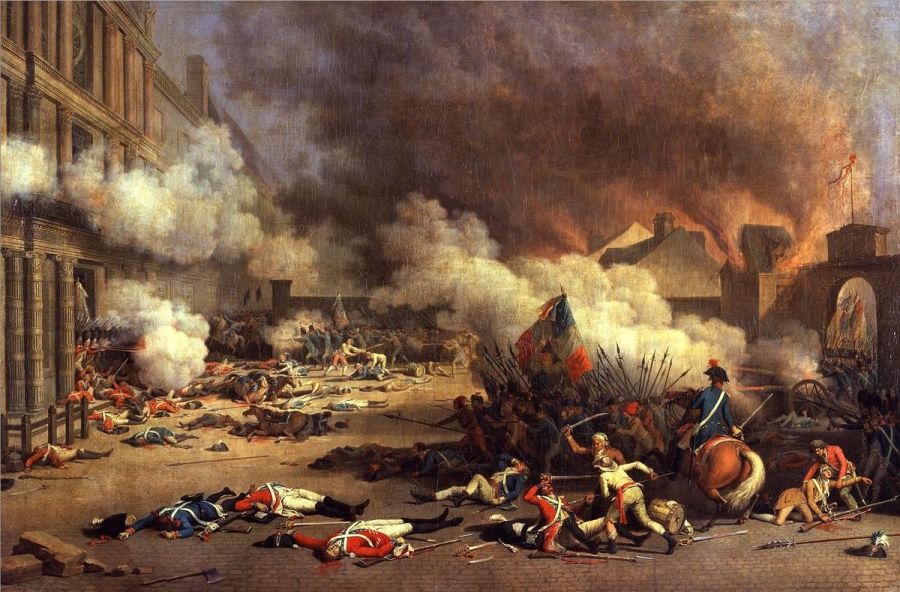
Every society can be likened to a swirling whirlpool of conflicting interests: a volatile amalgamation of disparate constituencies operating under a largely uniform set of values which are defined as ideology, faith, morality, or tradition. Each interest group is a current of its own, driven by a distinct set of demands and agendas, thus it is endowed with momentum and direction that differ from all others. If any one current gains too much power, then it begins to direct others and form a state of its own. If any one current grows too weak, then it is absorbed by another and destabilises the state. At the heart of this vortex is the government, whose paramount duty is the preservation of relative harmony in this chaotic maelstrom of myriad discordant elements. The primary strategy employed by a healthy, functional regime is the prevention of conflict at all costs. Utilising the previously listed forms of societal values, the government constructs order among the chaos, usually through politics, laws, hierarchies, symbols, rituals, propaganda, and social customs. It weaves the myriad divergent threads of humanity into a shared narrative which unifies the disparate. It enables each constituent to view negotiation as the favourable and legitimate resolution to potential clashes of interests. The enduring task of governing regimes is to ceaselessly perpetuate this shared story amongst its people.
Conflict, however, is unavoidable due to the three core principles that govern humanity. First, humans are biological organisms sustained by daily intakes of energy and molecules, and are thus subject to nature’s law of competition. Resources are by definition scarce, and humans are driven by both instinct and reason to acquire as much for themselves as possible. Civilisation strives to be the bane of nature, but carnal desires still dictate the ways in which humans operate given that they are the evolutionary basis of our psyches. Cooperation is the highest form of competition, and thus statehood is merely the final step in humanity’s evolution, not its termination. Second, societies are built on inequality, for humanity remains bound to nature, and nature thrives on inequality. It is from differences that all species emerged, and it is in differences that all species perish. Members of a species are 99.99% identical to one another, but it is by focusing on the 0.01% of selective advantage that carbon base organisms on Earth evolved to such a high level of complexity. Humans are no different: the top 10% of our population can accomplish far more than the rest combined. Governments are obliged to forge a delicate path between forced equity and tolerance for inequity. Lean too much towards either side, and the vortex implodes. Third, change is the only constant, but the rate of change is not constant. The economy might develop rapidly, but the bureaucracies and laws which govern it will lag behind, and vice versa. This creates a fundamental dissonance, a growing rift from which conflicts are born.
Even though strife is inevitable, a healthy government is able to suppress conflicts and enforce the code of peace amongst the constituencies which it governs by harnessing the power of said constituencies. When two currents come into conflict, the government borrows the strength of all other currents to dispel the conflict. For as long as the vast majority of interest groups believe in the government and are bound to the state through common interests, conflict, even when arisen, can be safely defused. The preservation of this fragile balance is the hallowed duty of government, but when the vortex spirals out of control and conflicts escalate into fateful deadlocks of interests, the state implodes, collapsing upon the government at its centre.
Every government is destined for failure due to the nature of our world. One of the axioms which sustain the discipline of history, and indeed, humanity as a whole, is that change is constant and inevitable. A government that is perfectly adept at preserving peace in the 1200s AD would be dysfunctional by the 1400s AD if it does not react to the new circumstances and adapt accordingly. The reason for this universally inexorable fate is twofold: the law of inertia and the tendency of government to develop into a distinct interest group of its own, both of which leads to the terminal calcification of the state’s political apparatus. A man, just like all other organisms, is by nature resistant to change, and since a state is a man multiplied and his traits magnified, it too is reluctant to embrace transformative initiatives. Those in power, or the dominant currents in the vortex, would obstruct innovations at all costs, as dictated by the need to protect their own interests, whilst those not in power, or the economically or ideologically inferior constituents of society, are compelled by the desire to overturn their misfortune to lobby for change at all costs. Any governmental initiative to adapt the state to be better suited for the present circumstance thus poses the danger of dividing the society, acting as a polarising agent of conflict: thus becoming counterintuitive to the goal of government.
When a state spirals out of control, two divergent paths are presented: revolution and negotiation. Throughout history, humanity has always adopted an uneven combination of the two, but whenever the state leans to much to either side, disaster ensues. Revolution is the abrupt and often violent overthrow of the calcified remnants of the old government with the intent of equipping the state with a new system of governance best suited for the current circumstance. But this process is highly destructive, as it shatters the values which once provided the foundational illusion that the various interest groups of the state are bound together by nature and not just by interest. Once it is revealed to all that the state is merely an amalgamation of disparate currents rather than a unity of identity, faith, ethnicity, and beliefs, society usually explodes after its initial implosion. In this state, humanity is reduced to primal predation: the strong preys on the weak, and warlords rule the lands. A man is defined by his memories, they make him who he is, provide him with comfort when he is weak, joy when he is melancholic, and guidance when he is lost. A state, being man multiplied and magnified, is the same. The cultural heritage of a nation, if destroyed amidst a revolution, leads to violence, madness, and anarchy as does a man robbed of his memories. Continuity is the most central component in a society, and revolution is veritably the severance of this crucial thread. In Chinese, the word for revolution best illustrates this aspect of social change: 革命, “a change in destiny”.
 Veni Vidi Veritatem