
Part 1: https://venividiveritas.com/2023/01/24/queen-of-cities-a-fictional-tour-of-constantinople-in-540-ad/
The visages of sages past observed in hushed reverence as I was led through the monastery by Ecritius, their faces immortalised in melancholic mosaic. Golden incense holders and candelabras glittered as the candle flames swayed, contorting like the lithesome frames of Oriental dancers. Either side of me, monks garbed in unassuming raiments scurried pass, their creased and weathered faces locking in their frowns a contemplative sadness. The main hall, although filled with pious and godly men, felt empty and lifeless, its enormous ceiling hanging high above me like a man-made heaven, starless and morose in its vastness. I could hear the recitation of hymns and sacred psalms emanating from distant, unseen rooms, filling the grand and vacant space with an eerie chime, like a whisper with the voices of a thousand men.
It was with great relief that I discovered the relative austerity of my dwelling. The dim, quiet, and odourless room providing me with a sense of normalcy which I desperately craved. Ecritius soon brought me a simple meal of grapes, dates, olive oil, and bread, which I bid him partake by my side. Shedding my travel cloak and donning a more presentable tunic fit for a magisterial emissary, I spoke to my dutiful guide as we broke bread together, who revealed to me in the company of fine wine his Vandal origins. It was only then that I realised how young the man was, soft features and fair complexion, he could not have been more than twenty-five years of age, and yet he spoke with a dignified eloquence rarely afforded to even elders. When I inquired him on the sublime nobility with which he carried himself, his lips twisted into a mournful smile.
His father was a noble retainer of Gelimar Rex, chief of the Vandals, he divulged with a voice devoid of its characteristic smoothness, but lacked the good fortune to fall in battle with the Roman legions. Captured and shackled, he had sailed the Mediterranean to walk in Belisarios’s triumph, in which he was strangled to the deafening cheers of the Constantinopolitan crowd. The Vandal’s son, Hilderic, was then given a proper, Roman name so he could serve the men who killed his father and burned down his home.
Growing up in Barium, I had often heard tales of Vandal savagery—wild barbarians running amok in the Italian countryside raping and ransacking everywhere from Rome to Brundisium. But gazing upon Ecritius’s dark, coal-like eyes, I could conjure up only pity for the man who once upon a time called himself Hilderic. We sat in sullen silence after the grim revelation of his life’s tale, wordlessly soaking up the misery that had been released into the arid air. Downing his cup of wine, it was my guide who first regained his composure and informed me with due decorum of my invitation to join Ioannis the Cappodocian—praetorian prefect—at dinner tonight in the Palatium Magnum. With a polite bow, he retreated from my room, leaving me by my lonesome in a city of five hundred thousand souls.
Knowing that evening was still many hours to come, I decided that napping would be the wisest course of action. A throbbing headache had begun to emanate from the back of my brain, and I rightfully concluded that I would need to be of sound mind for the occasion tonight. Ioannis was known to be a man of guile and artifice, and to engage with him in a battle of wits and rhetoric over dinner for the sake of my city and my fellow citizens demanded the greatest mental fortitude.
Sleep, to my surprise, came swiftly in the serene darkness of my room. Images of Constantinople and its spectacles flashed briefly before my eyes, but my exhaustion soon overpowered even the most mind-shattering of visions. I wished only for deep and undisturbed slumber, and yet, it was not to be, for the Lord saw fit to deliver to me in my moment of delirium a most abhorrent of visions.
“Many are the woes of heaven.”
I found myself prostrate in a great, damp hall, my knees pressed hard against moist, crimson tiles.
“Many are the pleasures of man.”
The voice was enchantingly mellifluous, reciting the blasphemous incantation in the most beautiful of manners.
“Look upon these hands, red with the blood of thirty thousand men.”
“Look upon my breasts, craving the caress of ten thousand more.”
Beating back the urge to regurgitate the contents of my meal, I raised my head, my eyes frantically searching the great and empty hall to find the source of this seductive voice. The sight which greeted my eyes was ghastly indeed. In front of me, on a throne carved of porphyry stone, knelt a giant of clay and gold. In his crimson hands he held a sword and a cross, and upon his head was seated a nubile girl, raven haired and ravishingly nude, holding in her embrace a mud-caked goose. Beneath a gemstone diadem of gold and purple her face was a shimmering mirage of frightful beauty, and where a woman’s nipples stand there were only two gaping holes. Her lips alone remained unmoving, although I knew for certain it was from her dainty throat that the blasphemous verses originated.
“Be afraid, my child, for all that is purple will fall.”
And with that final warning, the throne began to ascend, propped high atop a mountain of skulls. Lifted unto the ceiling by grotesque chains of mangled limbs, the giant and the prostitute disappeared into the darkness, as if swallowed whole by the abyss borne upon their very shoulders.
There I was, alone and quivering, blind and directionless, stranded in a dreamscape I did not know. My joints were bloated and heavy with fluid. I could only crawl in a pitiful manner on the sickeningly moist tiles of the floor. I cannot remember for how long I languished in the void, inhaling the suffocating moisture of the air into my lungs as I searched for an exit in a desperate frenzy. It was only when my limbs’ growing turgidity prevented any effective movements at all that I began to notice the fading of darkness, banished by a gratifyingly bright ray of light.
And there he was, a tall, fair-haired man wrapped in flowing white robes, descending from a place beyond the stars. He held in his cupped hands not a cross nor a sword, but a squirming rat, fat and swollen like a pimple. With tenderness which I once thought belonged only to women, he wrapped his fingers around my chin. Enthralled by a mystifying force, my mouth opened by its own volition. The figure grinned with delight as he slowly lifted the loathsome rodent to my lips, which were no longer my own to command, and pushed it inside with such immense force that I thought for certain that my throat was to be crushed by his pale, steely fingers.
“Let it in.” He whispered, and with that, his ivory skin melted into blisters and buboes, revealing beneath it the rotten carcass of a man long passed. Within his fractured ribcage, tens of thousands of maggots writhed in vacuous splendour, and where once his heart was held, only a hollow rock, alight with fire, remained.
I awoke to a bedsheet drenched in sweat.
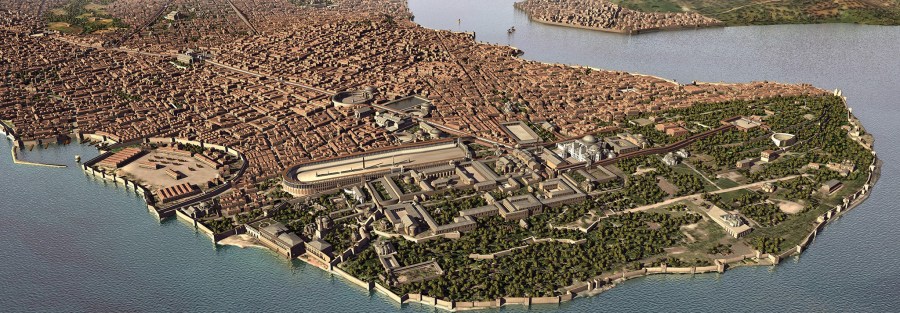
I have no memory of my journey from the Stoudios Monastery to the Palatium Magnum. I can recall only the jagged outline of the imperial residence, black against the fading sun, growing larger and more hideous as my carriage approached the Chalke gate. Adorning the grand entrance was the hallowed icon of Christ the Redeemer, who smiled at me with such warm affection that I could not help but shudder in the velvet cushion of my seat.
To be continued…..
 Veni Vidi Veritatem
Dayumn
LikeLike
Pingback: The Queen of Cities Part 3: House of Man – Veni Vidi Veritatem